Wednesday, 19 July 2017

Rama & Sita- Valmiki's Yogic Metaphors

-Kirti Tarang Pande
Originally Published in Daily Bhaskar


The most interesting thing about Rama is that everyone feels strongly about him, because he is different to different people- with scientists finding evidence of ‘Ram-Setu’ a historian may look at Rama differently from a mythologists’ point of view. Those with romantic hearts see him as a passionate lover who walked across jungles all the way to Sri Lanka for Sita. A feminist may look at him as the man who disowned his wife. In present India, your views on Rama maybe decided upon by your political allegiance or vice-versa. Do you know why it is so? You may love him or hate him, but why you can’t ignore him?

Who is Rama?

As always, the simplest answer lies in Yoga. Sankhya Darshan, the philosophy from which Yoga & Ayurveda have emerged, uses Rama as a metaphor for Self Realization. Goswami Tulsidas has said,

“Ja ki rahi bhawana jaisi,
Prabhu moorat dikhe tin waisi”

Everyone paints Rama with their own brush

At Home Yogis’ Home, we initiate our students in Self-Realization meditation, where they discover themselves through their version of Rama.

How is finding Rama relevant to everyday life?

If we are in bondage of Maya, we can never find Rama. Bondage of Maya means limitation of perception. Only the things that we see through our senses come in our experiential field. Our experience forms our memory. Our memory tells us what we can do and what we can’t. This is what cages our true potential. Imagine, how our story would have turned out if our monkey ancestors would have been caged by their perceptions?

They would have thought, “We have never seen an ape on two legs? In our memory we can’t recall a monkey that ever walked on twos. We can never walk on twos”.

Thankfully, they didn’t allow themselves to be caged by perceptions and we evolved into bipeds.

Literally, monkeys can evolve if they break-up from Maya (limitations of perceptions) and take refuge in Rama (become self-relized). Just visualize what benefits we can draw from it as humans!

But how to find Rama?

Rama can only be discovered through Sita.

Valmiki through his Ramayana, shares the yogic path of self- realization in a poetic way. So, instead of clear philosophical reasoning we get visual metaphors.

Rama is self realization & so is Sita. Rama is the ‘action’ aspect of the consciousness while Sita is the ‘bliss’.

 Laxman guarding them is our ‘buddhi’- ability to discriminate . Bhrittrhari in Niti Satakam says;

“Aharanidrabhyamaithunam ca samanyametat pasubhirnaranam|
Buddhirhi tesam adhiko viseso buddhirvihinah pasubhih samana||”

Meaning, it is the Buddhi, the discriminating power, and it is the freedom of choice that characterizes us as human beings. Otherwise, food, sleep, fear & sex are the attributes of animals too.

Till now we have got our ‘self’ that’s pure consciousness comprising of action & bliss, which guarded by our discriminatory power. The minute we let down our discriminatory power, the bliss is gone. The minute Laxman leaves Sita, she is abducted by Ravana. Ravana is Sankhya Darshan, a metaphor for Maya and ego. When we are trapped by the limitations of our perceptions, how can we achieve our goals? How can we find bliss- Sita?

That’s when Rama takes help of Vayu putra Hanuman. Hanuman represents our Prana-the life force. The Vayu within us, the oxygen that we take in is our life-force. We can’t live a minute without it. It’s when we devote our life-force to self-realization, as Hanuman is devoted to Rama we can find our true potential, our bliss.

How to channelize our life-force?

Swami Vivekananda has given us four paths to it:

1. Bhakti Yoga: We surrender to Hanuman and focus our senses to devotion of Hanuman.

2. Raja Yoga: By practicing pranayams, keeping our awareness fixed at the breath.

3. Janana Yoga: Reading & understanding the essence of Ramayana with respect to the metaphors that it contains. Then, transferring that wisdom from the realm of intellect to the realm of action.

4. Karma Yoga: Staying in the present all the time, guarding our actions, thoughts & speech with discrimination and freedom of choice.


Five Tantric Ways of Success

-Kirti Tarang Pande
Originally Published in Daily Bhaskar


In my last Tantra article, I promised that I will be sharing practices of Safe Tantra- ones that don’t require a Guru’s supervision.

How it works:
To understand & be able to use the power of Tantra in our day-to-day world, it is essential that we first know what this day-to-day world is and who we are.

Sankhya Darshan says that this seen world is created with Panchamahabhoota (Five basic elements)-
1. Kshiti (Earth)
2. Jal (Water)
3. Pavak (Fire)
4. Akaash (Space)
5. Sameera (Air)

According to Taittiriya Upnishad, our Annamayakosa (our gross physical body) is an amalgamation of these Panchmahabhoota.

At initiation level, we use Tantra as a technique of shuddhi (purification) of these Panchmahabhoota. This prepares not only our physical body to receive, accept & assimilate the explosion of our Shakti but in the realm of realism, it imparts success to us.

Now the question is-

How to purify Panchamahabhoota through Tantra:

Simply follow these five easy steps, one for each mahabhoota in your daily life;

1. Kshiti (Earth)

Earth gives us stability. The stability is essential to us but it comes with Tamas (inertia). This inertia prevents us from taking necessary actions in the direction of success. Therefore, in order to bring any kind of desirable change in our lives it’s crucial that we minimize (if not eliminate) the Tamas within us.
This can be done by understanding how Tamas functions. In my personal practice, I follow a simple thumb rule- anything that gives pleasure now but pain later is Tamasic & should be minimized if not eliminated.
However, the thing with Tamas is, it’s addictive. So, here’s a cheat trick to overcome Tamas addiction:

Cheat Trick:
Shitali, Shitkari & Sadanta are three pranayams that help in getting rid of any kind of cravings. Practicing each one of these three pranayams 9 times daily help in quenching the Tamasic yearnings.

2. Jal (Water)

Majority of tantrics concentrate mostly upon water element, because when it comes to physical body it’s the most important element. In fact, there’s an entire field of Tantric Alchemy dedicated to it, it’s called- Rasa Vidya- the knowledge of Rasa. It’s such an esoteric practice that there’s a test that one needs to pass before getting initiation into it. The test is called-

Gagan gamana, swarna karna (One should be able to levitate & turn base metal into gold).

This external alchemy is taken as a proof of internal alchemy that comes after an internal transformation. This transformation is a product of purification of water element inside our body.

This purification, according to Taittriya Upnishad, must begin at mental level. Water is Rasa in Sanskrit, so are our emotions. In order to purify water element at physical level, it is essential that we purify our emotions first.
In my daily practice, I find Mindfulness & a Tibetan meditation technique called Tong Len the most effective way of purifying emotions.

3. Pavak (Fire)

Placed in the middle of the five elements, fire acts as a bridge between the dense elements (earth & water) and subtle elements (air & ether). Therefore, to create balance in physical body purification of fire is indispensable. As a result, we find fire as a foundation of both the paths of Yoga- the known Vedic path & the secret Tantric path. In fact, the first word, of the first shloka, of the first mandala, of the first Veda is Agni- fire.

Since the fire exists in physical body in the form of acids, enzymes & melanin, the simplest way to purify it is through food.

This means, fixing number of meals, fixing meal time & eating only that food which doesn’t aggravate our dosha (Vata, Pitta, Kapha).

4. Sameera (Air)

The job of air is to move. If it’s not in continuously moving at right time & right rate, then it produces undesirable effects, especially in tubular organs.

The easiest way to purify air is to purify the channels through which it moves. In Patanjali Yogsutram, rishi suggested working on purification of three major channels called sushmna, ida and pingala; before dawn and right after dusk. He suggests so because while Ida & Pingala function the whole day but these are the time when it is easiest to get Sushumna to work.

The best way to do this is by practicing nadi shodhan pranayam for beginners & anulom-vilom (in the authentic way as mentioned in Patanjali yogsutram) by advanced practitioners. In my personal practice, I do so every morning at 5am, before stepping down from bed.

I can’t control how my day is going to be, but I can control how it begins- by balancing my body, speech & mind through Pranayams.

5. Akaash (Gagan)

If we go by the definitions used in Riga Veda, Akaash in its most complex sense is what we today call the quantum mechanical field, the vacuum energy. In its simplest form, Akaash’s that from which the particles that make this multiverse spontaneously emerge, some of them manifest themselves and create the seen reality. 

Therefore, the Riga Veda says that this multiverse is in a continuing process of externally manifested space & time.

This makes Akaash the trickiest of all the five elements- it’s not only the subtlest one but has the most complex function! So, the purification it has to be difficult.

No! Akaash maybe the most subtle thing around, it’s still a matter. (According to me, this is the fundamental difference between modern physics & Sankhya philosophy).    

The easiest way to purify any element is to figure out what creates the element & then removing the external particles. In Sankhya Darshan, it is believed that the Tanmatras create Akaash.

What are Tanmatras? Let’s leave that for another day, for now, let’s stick to the purification of Aakash. Patanjali Yogsutram talks of Pratyahara for this.

Pratyahara is simply cutting the food of the five senses. It is only when we withdraw from our sense, we get the window to experience the reality beyond the external manifestation of it.

At Home Yogis’ Home, we get a taste of that experience through ‘Naad’ meditation, in which through ‘Shanmukhi mudra’, we connect with the impulse that create the sound of our breath.  


By doing so, we don’t simply see things but we become a person of ‘vision’. To be a successful leader in modern economy it’s essential to be a visionary. We are going to discuss this in details next week. 

Wednesday, 5 April 2017

Meeting Durga Through The Path Of Rumi: A Journey From To Goal

-Kirti Tarang Pande
Originally Published in Daily Bhaskar


“Why should I seek more?
I am the same as he.
His essence speaks through me.
I have been looking for myself.”
- Rumi

Rumi used these words to define his meeting point with Allah, students of Home Yogis’ Home, a Nanded City, Pune based yoga centre, used the same thought to reach Durga this Navratri.

Shunning all the orthodox snobbery, they met daily at Home Yogis’ Home to connect with the Cosmic Mother through an amalgamation of Bhakti Yoga & Shakti Yoga. Coming from different walks of life, some are IT professionals, some are home-makers, some are business leaders & some belong to the Indian Airforce fraternity; yet, every morning at 6:30 am, they all are unified as yoga sadhaks in pursuit of awakening the inner Shakti.

“Channelizing inner Shakti is a sadhna & like every form of devotion it takes its own time. However, such group practices are an integral part of Home Yogis’ Home, as they instantly transcend us to our Anandmayakosa- seat of bliss”, explains, Pankaj Pandey, director Home Yogis’ Home.

The culmination of this ‘blissed out’ path of reaching Durga happened on Ramnavani, April 04, 2017.
Dressed in black & green to represent the control on inner Tamas (inertia)through inner healing, the students invoked inner Shakti via a yogic dance on the tunes of ‘Aigiri Nandini’.

“When our teachers initiated us into the practice, it sounded like just another of those fun things we do as a group. It started with us putting our heads into it. In no time our souls were involved too. We had no worries in our heads just a dedication towards inner awakening,” shares Rupa Pillai, student Home Yogis’ Home.

However, that’s not it. Kirti Tarang Pande, founder Home Yogis’ Home, explains the utilitarian aspect of it, “When we come together as a group for invoking the inner power, the sadhana converts into an anandmela.”
She further adds that by feeding upon the group energy, this practice expresses the divinity within, removes introversion & brings out hidden talents. She explains that this not only transforms us into leaders but works upon the five sheath existence of the human body:

1. At muscular level it brings deep relaxation
2. At pranic level it slows down breathing, enhances balancing & leads to increased life-span
3. At mental level it increases creative & will powers
4. At emotional level it enhances happiness in life & equipoise.
5. At intellectual level it sharpens intellect & calms down the mind.

Pankaj Pandey takes the discussion further by mentioning the four fold effects of this practice on the development of consciousness:

1. It imparts civic sense
2. Inculcates zeal for service
3. Instill a patriotic urge
4. Invokes a spiritual yearning.

“For me the benefit is simple, it kept in the present, so now I know that I am on the right path”, concludes Ms. Pillai with a smile.  


Thursday, 30 March 2017

THIS NAVRATRI CHANNELIZE THE INNER ‘SHAKTI’ IN THREE BREATHES

-Kirti Tarang Pande
Originally Published in Daily Bhaskar


Yesterday, we discussed Tantra, what it is and what it is not. Today, let’s kick-in Navratri by preparing our bodies for Tantra. Just to refresh, yesterday we talked about how Tantra is a technique of goal achievement by harnessing & focusing our inner power.

This is where Navratri comes in. Tenth Mandal of Riga Veda considers Navratris to be the auspicious time to invoke, channelize and harness the Shakti within.

Yogic concept of ‘Shakti’

This Shakti is ‘Mooladhar Nivasini’, that is, she resides in Mooladhar Chakra- the root chakra. Mooladhar Chakra is responsible for grounding us with this material plane- Khshiti, meaning the earth element.
Kshiti is considered to Tamasic in nature in the practice of Tantra. Tamas brings inertia. Therefore, Shakti by virtue of residing here becomes inert in nature.
In other words, we have an innate power but it is sleep mode. The only time we unconsciously turn it on, is during sex. That’s why it’s common mistake to equate Tantric practice with sex.
We are not aware that we doing it or how we are doing it, so we can’t harness it at our own will. However, the worst part here is that we dispel & just disintegrating the ‘Shakti’ outside our body. This implies that we are not even using it!

How to awaken this ‘Shakti’

Yogataravali Sutra in its 5,6 and 8 sholkas  mentions Bandha as the method to do this. It says:
By the practice of the bandha the dormant Shakti awakens and enters into sushumna nadi. The breath becomes kumbhaka (still), the rechaka (exhalation) and pooraka (inhalation) cease to function. Senses are purified and kevala (enlightenment) takes place.
In fact, Acaranga Sutra of Jainisim cites Mahavir Jain attaining enlightenment through Mula Bandha.

How to practice Mool Bandha?

Basic underlying principle of bandhas is that by locking certain physical muscles, we initiate an unlocking at mental & pranic levels.
Following this principle, we lock the physical muscles around Mooldhar Chakra, to unlock our Mooladhar Nivasini, our Shakti. There are two techniques to do this:
1. Antar & Bahir Kumbhak
2. Maha Mudra Khumbhak
At beginners’ level, one should practice Antar & Bahir Kumbhak.
Step 1 Finding the right muscles:
Now, to find these muscles, in my personal practice it follow a simple method. I imagine that I am stuck in crazy Mumbai traffic & my bladder is bursting. I really have to pee; instinctively my body contracts certain muscles. That’s it; those are the muscles (perineal muscles) we are working upon here.
There’s another way to understand this, where I put out pictures of our anatomy & mention different sets of muscles for men & women. As an instructor, I’ve learnt it the harder way that it just confuses the students.
Step 2 Preparing for the locking
Before locking, we must check if we are in sync with the first Niyam (Dos) of Yoga- Sauch (Inner & outer cleanliness). Our bladder must be empty for this practice.
You can start with sitting in Padmasana. Take a Pooraka (inhale), observe Kumbhak (hold the breathe in), let out Rechaka (exhale) observe Kumbhak. Do this three times to ease your body into Kumbhak.
Step 3 The lock
·         Sit comfortably in Padmasana and bring all your awareness to mooladhar chakra.
·         Breathe in deeply & hold your breathe.
·         Mentally contract the mooladhar chakra by contracting your perineal muscles. Visualize that mooladar chakra is being massaged with your thumb.
·         Chant the beej mantra- lam mentally & visualize the Shakti awakening at the Mooldhar Chakra
·         When it’s no longer comfortable to hold the breathe. Exhale.
·         Before you inhale again, hold the breathe.
·         Mentally contract the mooladhar chakra by contracting your perineal muscles. Visualize that mooladar chakra is being massaged with your thumb.
·         Chant the beej mantra- lam mentally & visualize the Shakti awakening at the Mooldhar Chakra
This is one round. You can start with three rounds & as your practice improves, you can take it up to 12 rounds.

Bonus: A cheat trick

To increase the time of breathe retention you can hold your fingers in Shakti Dharana Mundra- press the breathe base of the thumb with index finger. By doing so you will observe that your capacity of comfortably retaining breathe has doubled.

Caution:

1. It’s not advisable to practice this if one is suffering from irregular periods.
2. Shiv Samhita in Chapter 4 insists that this bandha should only be practiced in isolation.
3. In Vedic Yoga, bandhas are esoteric practices and should only be practiced under the guidance of a Guru. You can use this write up increase to discuss your initiation into Bandhas with your Yoga teacher; but don’t use this write up for practice (especially as a beginner).
In case, you’re a beginner and don’t have a good teacher, keep watching this space; soon I will be sharing how to prepare our bodies for Tantra without a Guru.


Wednesday, 29 March 2017

Sex or Black Magic- Let’s talk about Tantra

-Kirti Tarang Pande
Originally Published in Daily Bhaskar

What is Tantra? When I ask this question during workshops; in West, I find the answers equating it with sex/ yoga poses that guarantee good sex. Back home, however, the answer depends on socio-economic strata of my students. One class equates it with Black Magic & another with sex.
When we equate Tantra with either sex or black magic, we come close to knowing what tantra is, and yet, we are way off the mark!
Tantra as sex:
One-dimensional approach to Tantra, defines it as an expression of our innate energy. Isn’t that what sex is? Unfortunately, while engaging in sex, most of us are unaware of the results that will be manifested as a result of bringing this powerful energy into motion. It’s like we picked up a sharp knife, because it appealed to us. However, we have no clue how to use it. So, we are simply waving it all around. In the process, at times it’s cutting fruits, chopping woods and at times it’s cutting & chafing us.
Please note the key word above was ‘one-dimensional’. If we employ this ‘tantra means sex’ approach, we are just nibbling upon the skin of the mango, happily unaware of the delicious delight that exists under the skin of the mango.
Tantra as Black Magic:
Black magic is simply an unusual technique of goal achievement. Black or white, for any magic to work; a focused personal energy is required. So, sometimes certain Tantra practitioners lose their path and get tempted by the Tamasic things they can acquire by practicing tantra in deviation from the teachings. These methods sometimes arouse black magic. Remember, it’s called black for a reason- it backfires.
So, if both the approaches are inadequate, what shall we do? How should we approach Tantra?

What is Tantra?
Defining Tantra is difficult because it’s not a darshan (philosophy) but a kriya (practice). Therefore, in Sankhya Darshan (philosophy from which Yoga & Ayurveda originate) there is no reference to Tantra. The knowledge of Tantra Kriya is passed on through Guru-Shishya parampara (Tradition of Guru & Disciples) in an esoteric fashion. 
So, in my opinion, best way to have clarity about Tantra is to explore its root.
The root of the word ‘Tantra’ comes from ‘Tana’, in Sanskrit it means weaving. There’s another word originating from the root ‘Tana’, it’s ‘Tanu’ which means the body.
This makes Tantra a process of weaving to create an effect of some kind. For weaving one needs a thread, the thread we are using here is Shakti. Shakti is the cosmic energy manifesting in us as our innate power.
Does Tantra serve any practical purpose?
I remember asking this question to my Guru in Tantra, a Shaivik Aghori who never gave me his identity. After him bursting my bubble of sex & magic, I blurted, “Then what’s the point of all this trouble? Why does it interest you?”
He gave me a two words answer, “Panchmahabhoota shuddhi”
It means purification of five basic elements that envelop our Chetna (conscience) in this world, which are- Earth, Water, Air, Fire & Ether.
Adi Shankaracharya has said, “Tad Brahma Nishkalamhum Na Cha Bhoot Sangha”- when we transcend ourselves beyond a being of amalgamation of these five basic elements, we become one with the divinity that exists within us.
This idea of being divine interested me too. If it does the same to you, watch this space tomorrow, because I am going to share how.


Friday, 24 March 2017

Vegan Dessert Challenge- Day 5

- Kirti Tarang Pande

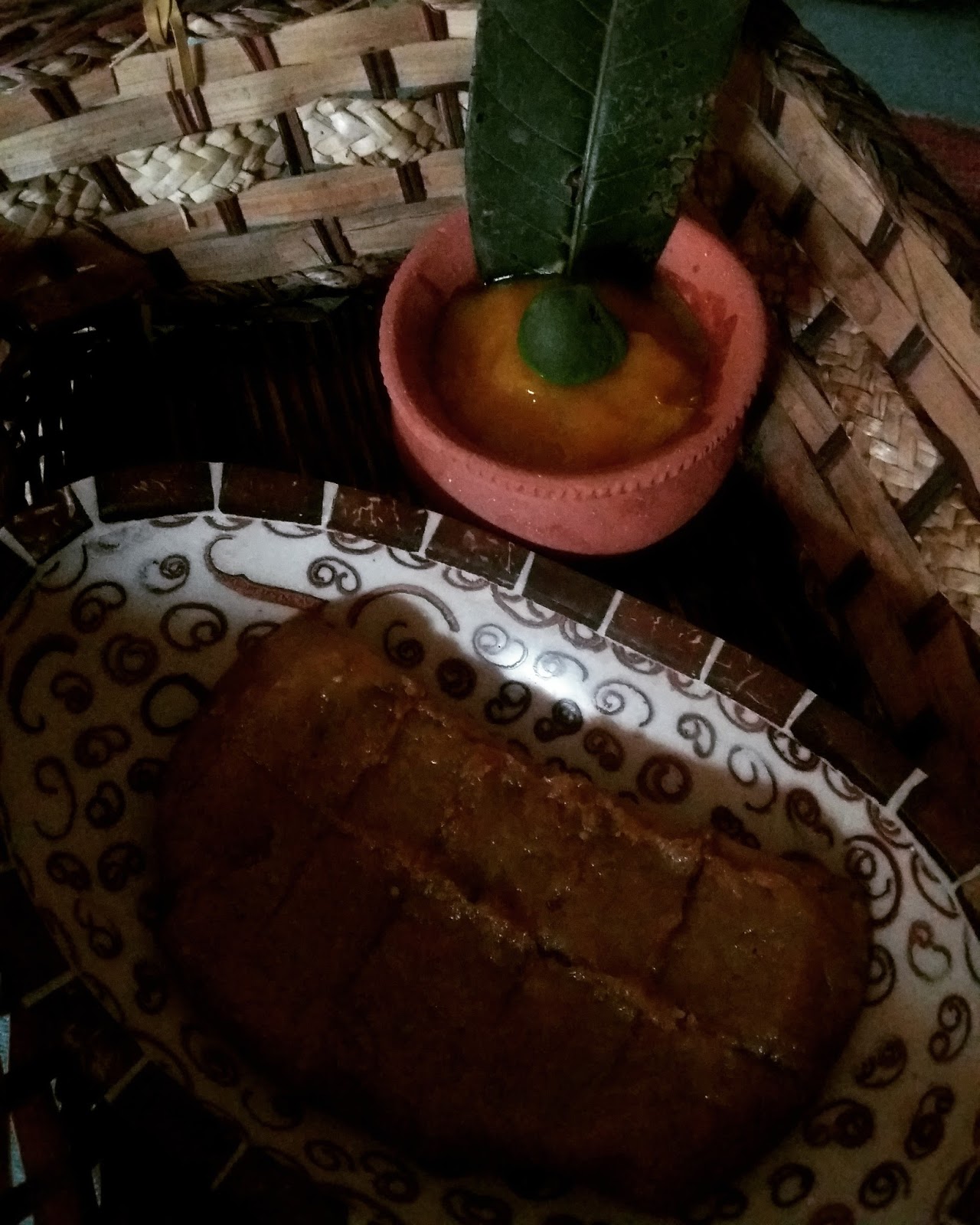
 Mango- Cashews Fudge


Ingredients:

  1. Fine ground cashews- 1/4 cup
  2. Grated/ Powdered Jaggery- 1 (tbsp)
  3. Coconut flour- 1/3 cup (optional)
  4. Water- 1 tbsp
  5. Salt - a pinch
  6. Mango puree- 1 cup
  7. Cardamom powder- 1 tsp
  8. Mashed Banana- 1 (if required)

Disclaimer:

Making mango fudge is little tricky for following reasons:

1. No matter how accurate your recipe is the mango is a uncontrolled variable. The amount of jaggery required depends upon how sweet the mango is. The mango that I have used is plucked from my garden, so I know how tangy it is, especially when the season has not yet properly arrived. I have used 1 tbsp of jaggery because I like  tangy & I don't want sweetness to overpower the flavor of cashews. I like things subtle but go with your palette. The trick is- less sugar is okay, you can always fix it by mashing bananas in it in the end.

2. We never know how thick the puree of mango will turn out to be. If it's too liquid, it becomes a test of patience.

3. For beginners dry roasting cashews in iron pan maybe difficult, so it's okay to use a non-stick in this case 

Method:

1. Boil jaggery with water in a deep bowl, till it you get the three string consistency. Another way to check consistency is take a bowl of water, add a drop of mixture to it. If it falls into the bottom in the shape of a ball, it's done.
2. Dry roast cashews & salt in an iron pan till they turn golden in a low flame.
3. Add jaggery syrup & the puree. Increase the flame. Let it boil, till you get the right consistency of a fudge. The mixture will become like a non-stick clay happily dancing to your tune in the pan. This tests patience. So, to fasten the process, you can add coconut flour too. I don't do it. I like the taste to be pure.
5. Drop the mixture in a parchment & press down with spatula. Allow it to cool & let it chill for an hour.

Wednesday, 22 March 2017

Vegan Dessert Challenge- Day 4

- Kirti Tarang Pande

 Walnut Halwa


Ingredients:

  1. Coarsely Crushed Walnuts- 1 cup
  2. Grated/ Powdered Jaggery- 3/4 cup
  3. Fennel seeds- 1 tsp (only in summers)
  4. Water- 1/2 cup
  5. Coconut milk - 1 cup
  6. Rawa (semolina)- 1tbsp
  7. Cardamom powder- 1/2 tsp

Method:

1. Boil jaggery with water & fennel seeds in a deep bowl, till it melts. Avoid fennel seeds if it's not too hot, since their aroma empowers walnuts'. Don't over boil jaggery otherwise you won't get the right consistency.
2. Dry roast semolina in an iron pan till it turns golden.Semolina prevents the halwa from becoming pasty.
3. Add the walnuts and cook over low flame till the mixture becomes dark brown like chocolate (approx 7 minutes). I prefer walnuts coarsely crushed to because of the texture it bring.
4. Add jaggery syrup, cardamom powder & coconut milk. Increase the flame. Let it boil till it becomes dry.
5. Serve hot. I love it so much that I don't garnish it with anything.

How is it different:

Tastes same. Looks same. Equally rich (courtesy: Omega 3 of walnuts).

Vegan Dessert Challenge- Day 3

- Kirti Tarang Pande

 Til Ke Laddoo


This is the simplest & quickest dessert in the world! Takes me just 5 minutes. So, I make it on the days, I have 6 am yoga class, so that I can wrap up with my cooking & be in Shala on time.

Ingredients:

  1. White Til- 1 cup
  2. Grated/ Powdered Jaggery- 1/4 cup

Method:

1. Dry roast tilin a heavy bottom iron pan.
2. Grind the til & jaggery together in the mixer
3. Roll out lemon sized balls. The oil from till will hold your laddoo together.
You're done!

How is it different:

It's not :)

Tuesday, 21 March 2017

Vegan Dessert Challenge: Day 2

- Kirti Tarang Pande

 Oats Kasar


Ingredients:

  1. Oats- 1 cup
  2. Grated/ Powdered Jaggery- 3/4 cup
  3. Saunf- 1 tbsp
  4. Water- 4 tbsps
  5. Geated Coconut - 1 tbsp
  6. Peanut Butter- 1tbsp
  7. Cashew nut & Golden Raisins: For Garnish

Method:

1. Dry roast Oats in a heavy bottom iron pan. It will bring out nice aroma to it. Don't let it turn turn brown. If your pan is nicely hot, it won't take more than 5 seconds. Clear the oats off the pan.
2. Dry roast grated coconut. Its aroma will compliment oats'. Clear it from the pan.
3. Add water in the pan. When it starts boiling (It happens quickly) add jaggery. When jaggery starts melting, add saunf to it. The taseer of jaggery is hot, in summers one must neutralize it with cooling effect of saunf.
4. When the jaggery dissolves add oats & coconut to it.
Side step:
At this point, I moist my palms with oil & roll 3 lemon sized laddoos for my husband (he is watching his calories)

Back to main cooking: 
5. When the mixture is dry, turn off the flame & add peanut butter. I make peanut butter at home- The usual way, just replace honey with Maple Syrup, because; a. I am Vegan, b. Ayurveda frowns upon mixing honey, oil & salt.
6. Garnish with raisins & almonds. 

How is it different:

Traditionally kasar is made by frying atta in ghee. So, this tastes nothing like the traditional one. It's not better/worse, it's totally different.


Monday, 20 March 2017

Vegan Dessert Challenge: Day 1

- Kirti Tarang Pande


Whenever we begin a new batch in our Shala, before I talk about Yoga, I talk about food. I do so on the last day & every other day!

The reason is simple. In Yogic Philosophy our gross body is referred to as 'Annamayakosa'. This means that this gross body is a sheath made of matter. This matter is the Panch Maha Bhoota (Five basic Elements) that we consume via food. In one sentence it would be: The food that we eat, makes us who we are.

In fact, if you're hosting a Yogi, the first thing the sadhak'll do upon entering your house is to takeover your kitchen. We have many rules regarding food. Sankhya Darshan (Philosophy from which Yoga & Ayurveda originates) discuss food before touching Ayurveda or Yoga. In food, before touching what to eat, it has a treatise on when & how to eat!

So, now you know how passionate we Yogis' are about our food.

In my personal practice, the rules that I found challenging in the beginning were:
1. Ahimsak/ non violent food- This meant no diary & honey
2. Only fresh food
3. No white sugar. Only natural sweeteners- jaggery, maple syrup. 
4. Nothing cooked in a microwave. 

The challenge came from my sweet tooth. I love to have some dessert at lunch. Can you think of a dessert that fits the above four criteria?

Initially even I couldn't. Then my mother suggested 'Murmure ke laddoo'. This opened a window of creativity & recipes began pouring in. 

As I spoke with more & more vegan people, I realized that they too struggle with gratifying their sweet cravings. This gave birth to #7Days7DessertsChallenge on my instagram. Today, being Day 1, I have picked up is different recipe.

It's different from other recipes because it takes 45 minutes to make it & requires efforts. Others are 15 minutes quicikies. You're going to meet them tomorrow onwards.

Today, let me introduce you to:

  Moong Dal Halwa


Ingredients:

  1. Moong Dal, yellow & split- 1 cup
  2. Grated/ Powdered Jaggery- 1 cup
  3. Rose Water- 2 tsp
  4. Cardamon- 4
  5. Water- 2 cups
  6. Coconut milk- 1 cup
  7. Golden raisins- 1tbsp
  8. Cashew nut- 1tbsp
  9. Grated cocunut/ Rose syrup (optional)
  10. Coconut oil: 1 tsp (in non-stick), 1 tbsp (in iron pan)

Method:

1. Overnight soak one cup moong dal in enough water.
2. Without using water, grind the dal into a smooth or coarse paste. Coarse adds texture & you can move to Step 3 quicker. Smooth is easy to cook. I prefer smooth.
3. Heat coconut oil in deep, heavy bottom pan. Amateurs must use non-stick, because the paste is sticky. Pros can try iron pan. Sankhya Darshan advocates for iron & frowns upon non-sticks.
Side step:
As the oil is being heated, on a different flame boil coconut milk with water & jaggery. Once it's boiled, lower the flame & let it simmer.
Back to main cooking: 
4. Now this the part that requires efforts & patience- roast the most dal paste. There will be three stages-
a. The mixture will be all sticky- use low flame & keep scratching it off with a wooden ladder.
b. Lumps formation- work your way through lumps
c. Lumps will disintegrate- can use medium/high flame- keep stirring till the mixture is powdery  
For 1 cup of all dal this step takes 25 minutes.
5. Add the coconut milk mixture, cardamon, raisins & almonds. On high flame allow the water to evaporate & the mixture to get the powdery consistency back. Towards the end, add rose water, here the mixture will require attention, stirring & low flame.
6. Take it off the flame. Garnish with raisins & almonds. My mother would use grated coconut too but husband doesn't like it, so I add rose syrup. 
7. Have it hot. 

How is it different:

Traditionally, 1 cup of mood dal will require 9/10 tbsp of ghee to get the right flavor. Also, instead of coconut milk, full fat milk is used. Rose water has no place in the recipe.

So obviously, this version has less calories. This however, comes at the cost of sacrificing the richness that comes from ghee. Moreover, frying dal in ghee brings out its irresistible aroma. That's the reason why I use rose water & rose syrup. It's nothing like the nose of moong dal but it blends well with coconut milk & the halwa still gets an aroma.  A yogi can't get too greedy after all :)

Saturday, 4 February 2017

Watch out! Everything You Know About Chakras Could Be Wrong!


-by Kirti Tarang Pande
Originally published in Daily Bhaskar

These days, you may or may not find a sea shell in Goa, but what you will find is a Chakra Healer, in every lane! Why single out Goa? The scene is same everywhere-  Bombay, Delhi, Himachal, internet. You landed up on this article, didn’t you? Even in my yoga classes, I have people enquiring,  “Do you teach Chakra Yoga?”, “Do you do Chakra healing?” One lady even asked, “Do you fill your Chakras?”  I don’t  know how to answer  to this. Mostly, because there’s no ‘Yes’ or  ‘No’  reply.  If you’re genuinely interested in Chakra  Healing, this is the answer that you deserve:

 CHAKRA MYTHS BUSTED

Myth 1: There are seven chakras in our body

Shiva Samhitha talks about 72000 nadis in our Pranic System. These are the vessels that carry our Pranic Energy, having 114 junction points (not seven) that we call Chakras.

Myth 2: Every Chakra has a corresponding physical organ

According to Shandilya Upnishad, Chapter I,  Maya-sakti  is embodied in human physiology as subtle centers of expressions of Consciousness (Caitanya), that we call as Chakras. In simple words, Chakras are a part of Cosmic Energy, an energy system much higher than our physical body. Therefore, their functions are in correspondence with our Cosmic existence not our needs of this physical plane.

Now the question arises- if Chakras are there to serve a Cosmic Purpose, why are they such an integral part of Ayurvedic healing? The answer is provided by Dhyana-bindu Upnishad which defines Chakras as centers where Nadis are given their purification. Any form of Chakra Healing method used in Ayurveda, is merely a pump used to flush out the blockage in Nadi system, so as to ensure the free flow of Pranic Energy and not fixing the organ that happens to near the location of that Chakra.  This brings us to your next myth.

Myth 3: “I went for Chakra Healing & it worked wonders!”

You may have gone for a Chakra Healing, the practitioner may have called it a Chakra Healing but actually happened was Pranic Healing. According to Yogakundali Upnishad, Chapter III, Chakras can be opened through inner practices of pranayams, mantra and meditation.  The process can be aided with outer measures like diet & gems. This opening clears the path of nadis for Pranic Energy to move freely and do the necessary healing.
The keyword here is ‘opening’, we are not ‘activating’ the Chakra here.  There’s a difference.  Chakra opening paves path to Pranic Healing. Chakra activation will open the doors to enlightenment.

Myth 4: “I went for a Chakra meditation & now I can feel my Chakras being activated”

Once again, let’s refer to Yogakundali Upnishad.  According to the Upnishad, there are only two ways of Chakra activation- Antaranga & Bhiranga.

Antaranga way: This refers to the inner way through meditation. To activate the base Chakra, it requires double the amount energy required for a normal body & brain to function in a day! Only a sadhak whose body is prepared through asanas, sattvic diet of food and thought, & whose nadis are balanced through pranayams can create that much energy. Channelizing that in right direction is another game. This we are just talking about the base Chakra. As we move up, the requirement of energy doubles.  Keep in mind that there are 114 Chakras in body & do the maths.

Bahiranga way: This refers to the outer path of Chakra Awakening- our actions.  One must understand that Chakra awakening/ activation is a method of reversing the process of creation so that we can unify with the creator. Therefore for instance, if one wants to awaken the Muladhar chakra, then one must withdraw from the element of earth. This can be done by giving up the desire (and actions) of earthly possession & accumulation.

So, how can I get Chakra Healing?

You need to ask yourself- why I am looking for Chakra Healing? If the reason is anything but the desire to be a jnani & reach the state of enlightenment, I strongly recommend switching to Pranic Healing. As according to Prasnopnishad:

Pranasyedam vase saevam tridive yat pratisthitam
Mateva putran raksasva srisca prajnamsca videhi na eti

(Meaning: Whatever exists in three worlds is all under the control of Prana. Protecting us as a mother protects her sons; giving us affluence and intelligence.)

However, if you’re in pursuit of Moksha, then I recommend finding a siddha guru with right motivation and taking refuge in him. Please note: Chakra Activation is a tantric process and should only be done under tutelage of a Siddha guru.

 How can I find the right Pranic Healer?

You already have one- You! No one can channelize your Pranic Energy better than you. You just need to know how. At my shala Home Yogis’ Home we always teach our students (even the beginners) basic pranic healing techniques, you can request your yoga teacher to do the same. Happy healing!


Monday, 28 November 2016

Your 'Gratitude Thinking' May Not Be Good For Your Karma

-Kirti Tarang Pande
Originally Published in Daily Bhaskar

Incidence 1

Recollect- The Rangbhoomi scene of Mahabharata, unchallenged, unparalleled Arjuna had stolen the show, he was about to be declared warrior of the day & that’s when it happens- arrival of Karna.

He wants to take on Arjuna, but due to his low-birth it was forbidden to him.
Duryodhana saves the day for Karna, by crowning him the King of Anga. What does Karna do?

Veda Vyasa in Mahabharata writes-
“Karna sets his emotions free to flow, through his eyes, in the form of tears. He asks Duryodhana, “How may I be of service to you?””

Now think- What you would have done in similar situation- a man saves you from a national humiliation, makes you the king! What would you say?
I would say, “Thank you”, as a reflex. Karna didn’t. Note the choice of his words,”How may I be of service to you”, and not, “How can I repay you?”
Does it mean Karna was ungrateful?

Let’s look at it from the prism of another incidence-

Incidence 2

Recollect- When Hanuman meets Sita in Ashok Vatika, as a messenger of Rama. He shows her Rama’s ring & tells her that her husband will be here to rescue her. How did Sita respond?

Rishi Valmiki writes,
“Upon knowing that he is a messenger of Rama, she blesses him. With a heart overwhelmed with joy & grief, she says; “Give your master my Pranam (salutation)”

Now think- If you were trapped by the most feared person of our times & suddenly someone comes and says, “Rescue team is on its way.”  Wouldn’t you thank that person or at least send your gratitude to the rescue team?
Sita didn’t
.
Does it mean Sita was ungrateful?
Before judging further, let’s understand what gratitude means?

In today’s society it’s the ‘trending’ thing. Saying ‘thank you’ not only reflects our politeness & manners but practicing gratitude gives one the most ‘in’ label of being a ‘spiritual person’ these days.

However, for true yogis & advanced practitioners of ancient Vedic wisdom (like Karna & Sita), this is a sign of ignorance- this gratitude towards another human being because s/he was of service to us.

Why?

Answer is given by Krishna in Gita. While talking about Vedic concept of Janana Yoga (The path of wisdom), 

Krishna says;

Gatsangasya Muktasya Gyanavstitchetasah|
Yagyayachratah Karma Samagram Praviliyate||
-Gita 4.23

Beyond attachment, free & with a mind established in knowledge, when he performs action for a yajna alone, everything is destroyed.

It means that when we perform an action, with the attitude of performing a yajna (a Hindu purification ritual of making offerings to scared fire), surrendering our every action as a service of society, one gets freedom from the bondage of Karma. There’s no negative or positive Karma attached to such an act. This is the easiest path of ultimate liberation (knowledge, happiness & bliss). Since, our Atman takes a body to pay dues for negative Karma & reap benefits of positive Karma.

Conversely, when we say ‘thank you’ we form a Karmic alliance with that person. The alliance is formed out of our ignorance of cosmic law; which in Gita, Krishna describes as:

“Na Mam Karmani Limpanti Na Me Karmaphale Spraha|
Iti Mam Yobhijanati Karmabhi Nars Badhyate||
- Gita 4.1

In Bhavatakmak way, it means that Atman, our inner & true self, isn’t interested in the fruits of actions that we perform. Since our inner & true self has the awareness that by performing actions in this way, it can’t be tied in the chain of Karma.

Our conscious mind may not be aware of this process though, because over the years we have become aloof to our inner & true self. In this equation, when we add ‘Thank You’, we hurt the person in two ways:

1. We take the person further away from the inner-true self.
2. We tie the person in Karmic cycle of birth & rebirth.

Then what to do?

There are ways:

1. Follow Karna’s model: Gift the person the pleasure to witness the joy the action has brought to you, by expressing our emotions. Then connect with your heart in the wisdom- That the person in didn’t do a ‘favor’, but merely performed his dharma. You, in turn, perform yours.

2. Follow Sita’s model: Bless or offer salutations to that person, whatever comes naturally to you. Please note- the blessing/salutations should be seated in love & not in gratitude.
For example- When we get a glass of water to our grand-parents, they don’t say ‘thank you’, they say ‘Bhagwan bhala kare’ (May God Bless you), ‘jug jug jiyo’ (May you live long) etc

3. Use ‘Namaste’ instead- Namaste means I bow to the divine in you. This means that you’re acknowledging that the performed action was yagna & you are bowing to that.
For example- Remember our good old Kirane wale bhaiya( grocery man), he never thanked us for shopping with him, like billing guys in supermarket nor did our parents thanked him for assisting in shopping, like we say to the sales girls in stores. They would simple say ‘namaste’ to each other & would (knowingly/ unknowingly) transcend their materialistic transaction to spiritual level.

4. Path of least resistance- You may say ‘thank you’ with your mouth, but keep your heart & emotions firmly seated in any of the above mentioned options.

Namaste!